Deutsch
 English
Kick-Off at IMEL
Foundation stone laid for interdisciplinary research
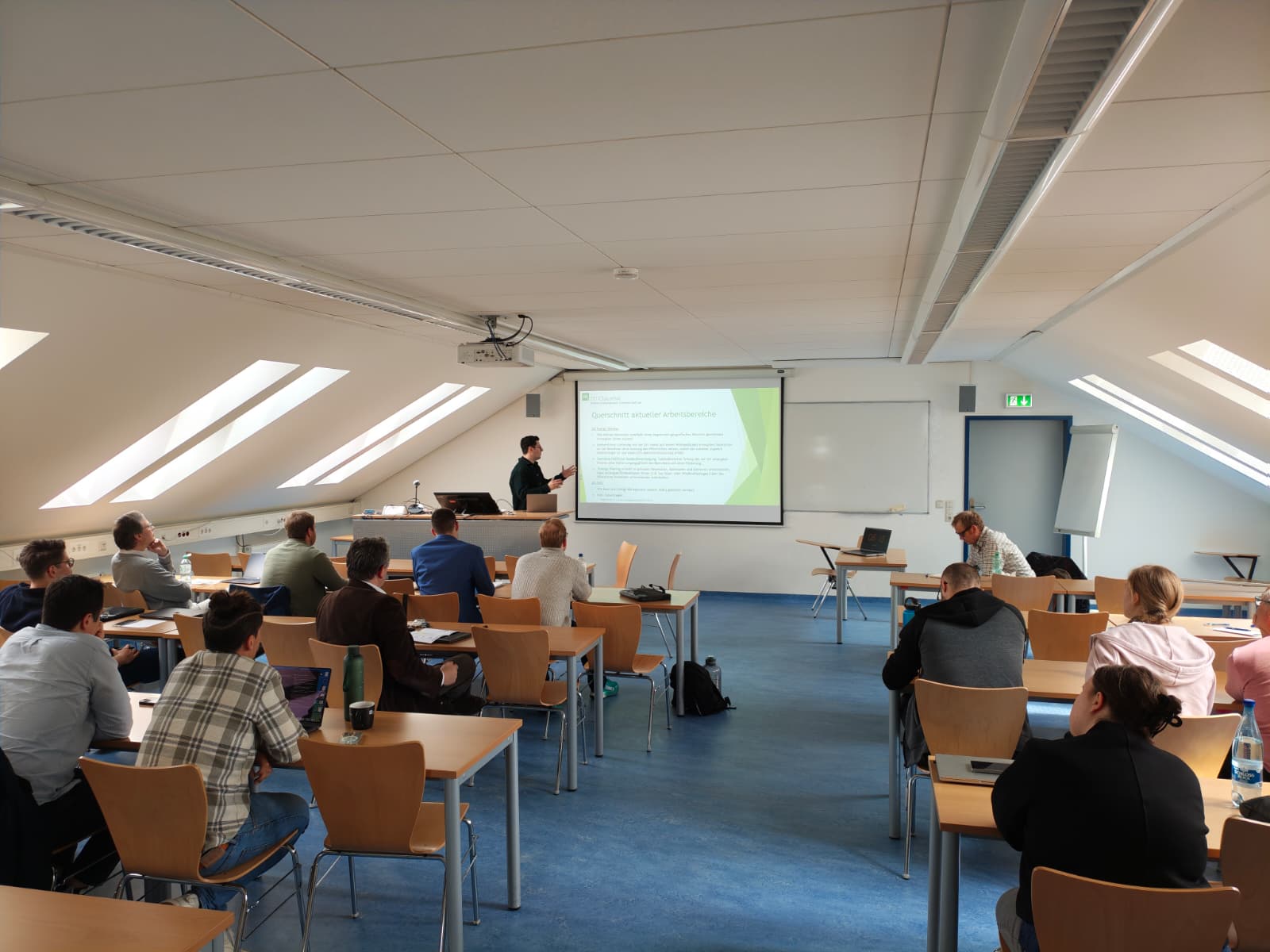
Wednesday, the 17th. June, a first joint workshop of the scientists from the fields of business and law took place at the Institute of Management, Economics and Law. In the seminar room 1, the young researchers of the former Institutes of Economics and for German and international mountain and energy law came together for the first time in this format to exchange ideas about joint research perspectives, methodological interfaces and future cooperation opportunities.
The initiative for the workshop was taken by the new head of the institute, Prof. Dr. Thomas Nobody out. The event was moderated by Prof. Dr. Roland Menges, who led through a compact program with several short contributions. The focus was not on classical research lectures, but on short pitches with gripping ideas, open questions and possible points of contact between the disciplines.
“The merger of the two areas of law and economy results in many interfaces that have not yet been used. The meeting showed how great the potential for joint research at the IMEL is. Through this exchange, many other interdisciplinary cooperations could arise," emphasized Prof. Dr. Thomas Nobody.
Felix Eckenfels, Jan Schlüpmann, Prof. Dr. Christoph Schwindt and Florian Scholz, Dr. Tim Friedrich, Bora Kocaoglu and Prof. Dr. Roland Menges and Prof. Dr. Fabian Paetzel advances her research approaches and ideas.
A special reference point was the circular economy, which plays a central role for the TU Clausthal and the IMEL. Because circular economy is not only a technical challenge, but also needs economic sustainability, sustainable business models and effective incentive structures that must be implemented in appropriate legal framework conditions. This is precisely where a particular strength of the IMEL lies: As an Institute of Management, Economics and Law, the institute stands in a special way for the “E” in Circular Economy, the economic and legal perspective on industrial transformation, sustainability and social impact.
Also Prof. Dr. jur. Hartmut Weyer emphasized the importance of this connection from a legal point of view: “Circular Economy succeeds only if economic concepts and legal framework conditions are thought together to implement the necessary changes. The IMEL can play a central role here because management, economics and law combine essential perspectives that are necessary for a successful transformation of the energy and raw material supply system.”
The event was characterized by constructive discussions, openness and great interest in the topics of the other discipline. It became clear that the combination of management, economics and law in many research fields can contribute to improved problem solutions – from questions of transformation and regulation to governance, sustainability and digitization to industrial change and social impacts.
Moderator Prof. Dr. Roland Menges drew a positive conclusion: “The short contributions have shown how many exciting ideas are already available. It was crucial today to get into conversation with each other, to find common terms and to build the first bridges between the research areas. This is exactly what this workshop was an important start for.”
The kick-off workshop laid an important foundation for future interdisciplinary research at the IMEL. The exchange is expected to deepen further in the coming months.